THE YOUTH SPORTS COACHING BRIEF
A Practical Guide on How to Coach Youth Sports, Master Parent Communication & Keep Your Composure Under Pressure
Prepared by Mike Nichols, Founder of the ACE Model
Dear Coach,
On a crisp, cold Saturday morning, two parents arrived at local sports halls to coach youth basketball teams.
They were very much alike, these two coaches. Neither of them had played professional sports. Neither had a degree in sports science. They were simply mums or dads who stepped up when their local club desperately needed someone to lead the team.
Both cared deeply about the kids. Both spent their spare evenings searching online for how to coach youth sports, looking up drills, and searching for practical youth sports coaching advice to do a great job.
But recently, there was a profound difference in their experience.
One coach stood on the sideline looking dishevelled, tired, and worn out. During games, he found himself projecting his own mounting frustrations onto his players—shouting instructions like "Get back on defence!" or "Move the ball!" to a group of teenagers who had completely tuned him out.
He drove home every Sunday afternoon with a tight chest, feeling like the joy had been sucked out of the weekend. Worst of all, the friction over parent communication and sideline pressure was starting to strain the relationship with his own child. What started as a gesture of love had turned into an exhausting, thankless chore.
The other coach was finding quiet, effortless success. He didn't need to pace the touchline or shout to be heard. He commanded a calm, quiet authority. His players weren't looking like robots waiting for instructions; they were communicating, self-correcting, and solving problems on the court themselves.
The parents on his sideline sat quietly, smiling and letting him work. He drove home feeling energised and fulfilled, and his child was incredibly proud to have him as a coach.
Have you ever wondered what makes this kind of difference in a volunteer coach's life?
It isn't a difference in basketball knowledge. It isn't that one coach has a more sophisticated tactical playbook or better set plays.
The difference lies in how they handle parent communications, manage human behaviour on the court, and protect their own peace of mind.
The Day an England Player Felt "Powerless" (And Learned How to Handle Parent Communications in Youth Sports)
My name is Mike Nichols. Unlike many grassroots coaches, I did grow up in the elite system. I represented England U19s, obtained my high-level coaching qualifications, and eventually became a Level 3 Coach and mental performance coach.
But I want to let you in on a secret: When I first started coaching, I was just as terrified, overwhelmed, and lost as anyone else asking themselves how to coach youth sports effectively.
I'll never forget a Saturday morning session I was running at Westhoughton High School in Bolton.
I was relatively new to this specific coaching role. I was teaching a simple layup drill. Suddenly, a parent got up from the bench. He didn't ask to help. He didn't give any warning. He simply walked right up to the layup line and started loudly shouting instructions to the kids—telling them to jump off the wrong leg.
I was stunned. An inner panic set in. I was an introvert by nature, and in that moment, I felt like a complete duck out of water.
Should I tell him to sit down? How do I say it without causing a scene? What if he takes his kid and leaves the club?
I managed to get through the session, but that moment burned itself into my memory. Like thousands of coaches who struggle with how to handle parent communications in youth sports, I realised that tactical knowledge meant nothing without a real framework for managing the sideline.
It made me realise something profound:
If I—someone who had represented my country on the court—felt completely paralysed and out of my depth by a single overbearing parent, how on earth is a volunteer mum or dad supposed to navigate this?

The Outdated Coaching Qualification Lie (Why Learning How to Become a Youth Sports Coach Requires More Than Tactics)
Let’s be honest. When you volunteered to coach, you did it out of love. You are the unsung hero of your community. You stepped up when everyone else stayed in their warm cars.
But no one warned you about the "double burden" of being a parent-coach.
You aren't just managing players; you are balancing your role as a leader on the court with your role as a parent to your own child. When the sideline gets chaotic, or parents start chirping, that stress doesn't stay at the sports hall. It follows you home.
Traditional national governing body qualifications show you how to become a youth sports coach on paper. They teach you the "X's and O's." They teach you how to run a layup drill, how to draw up a zone defence, and how to blow a whistle.
But they completely ignore the human psychology of the sideline.
They leave you entirely undefended against the true challenges of grassroots coaching: managing a complex web of player insecurity, parental pressure, and your own internal stress.
When a parent corners you in the car park after a game to complain about playing time, they aren't seeing the court objectively. Through my years of professional study in Emotional Intelligence, Neuro-Linguistic Programming (NLP), and Mindfulness, I realised that their brain is actively executing three cognitive errors:
Deletions: They completely delete the three defensive rotations their child missed.
Distortions: They distort a simple coaching correction into a personal attack on their child's self-worth.
Generalisations: They turn one good play in the second quarter into proof that their child is destined for the professional leagues.
When you don't have practical tools for handling sports parents during these emotional storms, you lose your composure. You get dragged into their conflict, and your peace of mind vanishes.
Introducing the ACE Sideline System
I spent over 25 years coaching at every level—from weekend kids' teams to professional clubs—and studying the science of human behaviour to solve this exact problem.
Modern coaches don't need another dense textbook; they need smart youth sports apps and actionable toolkits on their phone.
The result is the ACE Sideline System—a dual-force approach that pairs foundational theory with instant, real-time sideline support.
Your Two-Phase System: Modern Youth Sports Apps & Field-Tested Manuals
Phase 1: The ACE Coach App (Your On-Demand Support at acecoachapp.com)
We know that when a parent sends an emotional, demanding text message on a Tuesday night, or when you are sitting in your car with a racing heart before a high-pressure match on a Sunday morning, you do not have time to open a book or flip through a PDF.
You need elite-level guidance, instantly, in your hand.
That is why the heart of this system belongs to the next generation of youth sports apps: the ACE Coach App.
Built entirely on the ACE High-Performance Architecture, this private, highly tailored digital companion acts as your personal, 24/7 coaching mentor.
The Tuesday Night Text: Simply type, "A parent just texted saying their child should play more, how do I reply politely but firmly?" ACE Coach instantly outputs a stress-free, professional script for parent communication that you can copy, paste, and send in seconds.
The Pre-Game State: Open the app in the car park before a match to access a rapid 3-second psychological reset, priming your brain for calm, quiet authority before you even enter the building.
It is like having a professional sports psychologist and master tutor in your pocket—giving you the ultimate edge in grassroots sports coaching whenever stressful sideline scenarios strike.
Phase 2: The ACE Sideline Manual (The 20-Page Blueprint Companion)
Most sports psychology books are 300-page academic textbooks written for university lecture halls. I know you don't have the time to wade through endless, dense theory. You are running this team in the spare hours of a busy life—between your day job, your family, and your own sanity.
That is why The ACE Sideline Manual is a laser-focused, 20-page tactical field guide designed to accompany the app.
It contains zero fluff and zero filler. It is designed to be read in a single sitting on a Thursday evening to give you the structural foundations for mastering how to coach youth sports:
The Three-Way Alignment Charter (Page 8): A ready-to-print, one-page agreement for parents, players (12–17), and yourself. It draws a firm, respectful line in the sand before the season even starts: Parents parent, coaches coach, players play.
Neutralising the Car Ride Home (Page 10): This section gives you the exact framework to stop parents from dissecting your games in the car, protecting young athletes from performance anxiety and protecting your own relationship with your child.
Composure & The 3-Second Reset (Page 13): Master a high-performance state-management technique to instantly lower your heart rate and maintain cool focus when a referee makes a terrible call or a parent starts shouting.
The "Car Park" Scripts (Page 14): Word-for-word templates of exactly what to say when an emotional parent corners you after a game, allowing you to de-escalate parent communications in under 30 seconds without losing your authority.
Edge & The Questioning Blueprint (Page 16): Discover the 3 specific questions that force teenage players to step off the "railway lines" of passive instruction and start communicating, thinking, and self-correcting on the court themselves.
Two Paths Next Sunday Morning: Transforming How You Coach Youth Sports
You have two paths you can take when you step onto the court next weekend.
Path A (The Default Path):
You continue doing what you've always done. You keep trying to out-shout the noise, joining the ranks of the touchline ranters. You keep absorbing the emotional distortions of parents because you lack a structured strategy for parent communication. You continue driving home with a tight chest, feeling unappreciated, and letting the stress leak into your family life. Eventually, the friction becomes too high, and you walk away from a game your child wanted you to coach.
Path B (The ACE Path):
You download one of the most effective youth sports apps directly onto your phone . You immediately align parent expectations using the Three-Way Alignment Charter. You master your internal state using the 3-Second Reset. You command absolute, quiet composure on the sideline. And you use your Edge to unlock the true potential of your players, learning how to coach youth sports with genuine confidence while making these years some of the most rewarding and beautiful memories you will ever share with your child.
Best of all, you don't have to risk a single penny to test this on your court. You can create your account for free today, download the 20-page manual, and use your first 7 support messages completely on us.
Visit acecoachapp.com to claim your 7 free support messages today.
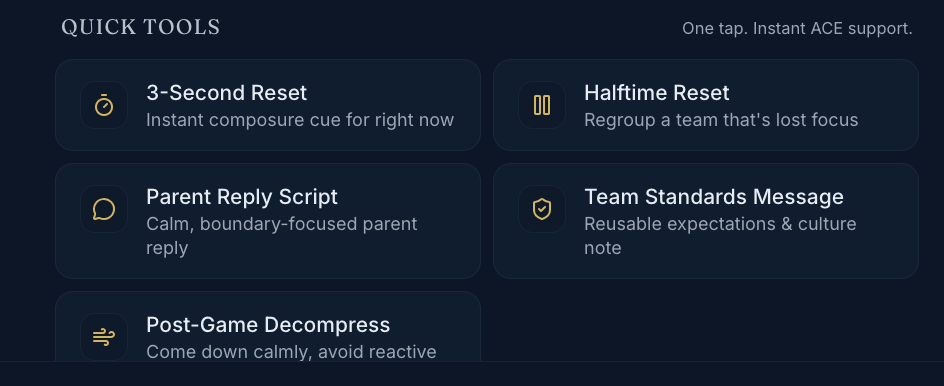
Support That Stays Calm Under Pressure
When you are ready for steady, week-to-week sports coaching support, we offer simple, flexible monthly plans designed to fit your specific coaching schedule. There are no long-term contracts, no lock-ins, and you can change or cancel any time directly from your account.
ACE Starter (£5.99 / month): Perfect for coaches dipping into ACE when specific moments arise. Includes 20 support messages per month and full text refinements.
ACE Standard (£11.99 / month): Our most popular plan for consistent, steady week-to-week support. Includes 50 support messages per month and full text refinements.
ACE Premium (£24.99 / month): A high-use plan for coaches managing multiple squads or intensive schedules. Includes 150 support messages per month and full text refinements.
Need a temporary boost? If a particularly busy tournament week needs it, you can instantly top up your account with extra message bundles starting from just £3.99, one-time purchase.
Sincerely,
Mike Nichols
Founder, The ACE Model
England U19 (Former Player)
Level 3 Coach & Mental Performance Coach
P.S. If you are like most parent-coaches, your biggest constraint is time. You are likely running this team between a busy job and family life. That is exactly why the ACE Coach App is built for speed compared to conventional youth sports apps. It doesn't require you to study for hours—when a situation hits, you type it into your phone, and it gives you instant, real-time answers in under 10 seconds.
P.P.S. Because your account starts entirely free with 7 complimentary messages, there is absolutely zero risk to you. Test the "Car Park" scripts, ask it how to handle parent communication with your toughest parent, and see the difference in your peace of mind before you ever choose a monthly plan. Claim your free access right now at acecoachapp.com.
Frequently Asked Questions
Q: Is the ACE Coach App suitable for youth sports coaches across all sports?
A: Yes, absolutely. While many of our examples come from basketball, the ACE framework is built on foundational human psychology, emotional intelligence, and state management. Whether you coach basketball, football, rugby, netball, swimming, or athletics, the pressure on the sideline and the dynamics of parent communication remain identical. The strategies transfer seamlessly across all youth sports.
Q: Can the ACE Coach App be used by coaches other than parent-turned-coaches?
A: Indeed. While parent-coaches face a unique "double burden" of balancing family dynamics with team leadership, the ACE Coach App is designed for any grassroots coach, assistant, or club director looking to elevate their leadership. Whether you are a young coach starting out, a seasoned volunteer, or an experienced mentor, the app gives you instant tools to manage player composure, establish clear boundaries, and command calm authority on the touchline.
Q: How does ACE Coach help me handle parent communications in youth sports?
A: ACE Coach gives you instant, word-for-word response templates for tough conversations—whether it’s a late-night text about playing time or a confrontation in the car park. Instead of reacting emotionally, you get calm, professional scripts grounded in proven psychological frameworks like NLP and Emotional Intelligence.
Q: Is this app suitable for brand-new volunteer coaches?
A: Absolutely. If you are learning how to coach youth sports while balancing a full-time job and family life, ACE Coach acts as a 24/7 mentor. It bridges the gap that standard NGB coaching badges ignore—teaching you how to manage sideline behaviour, player confidence, and parent expectations.
Q: What makes ACE different from other youth sports apps?
A: Most youth sports apps focus purely on administrative tasks like attendance and scheduling. ACE Coach is a real-time psychological performance and communication assistant built specifically to protect your composure, improve player alignment, and remove sideline stress.
Q: What happens after I use my 7 free messages?
A: You can continue on our free tier with your downloaded 20-page manual, or choose a low-cost monthly plan (starting at £5.99/mo) that fits your match schedule. You are never locked in, and you can cancel or change tiers anytime.
Want to know more about our overall mission and local services? Visit our main website xedgeperformance.co
All Rights Reserved.
Create Your Free Account